

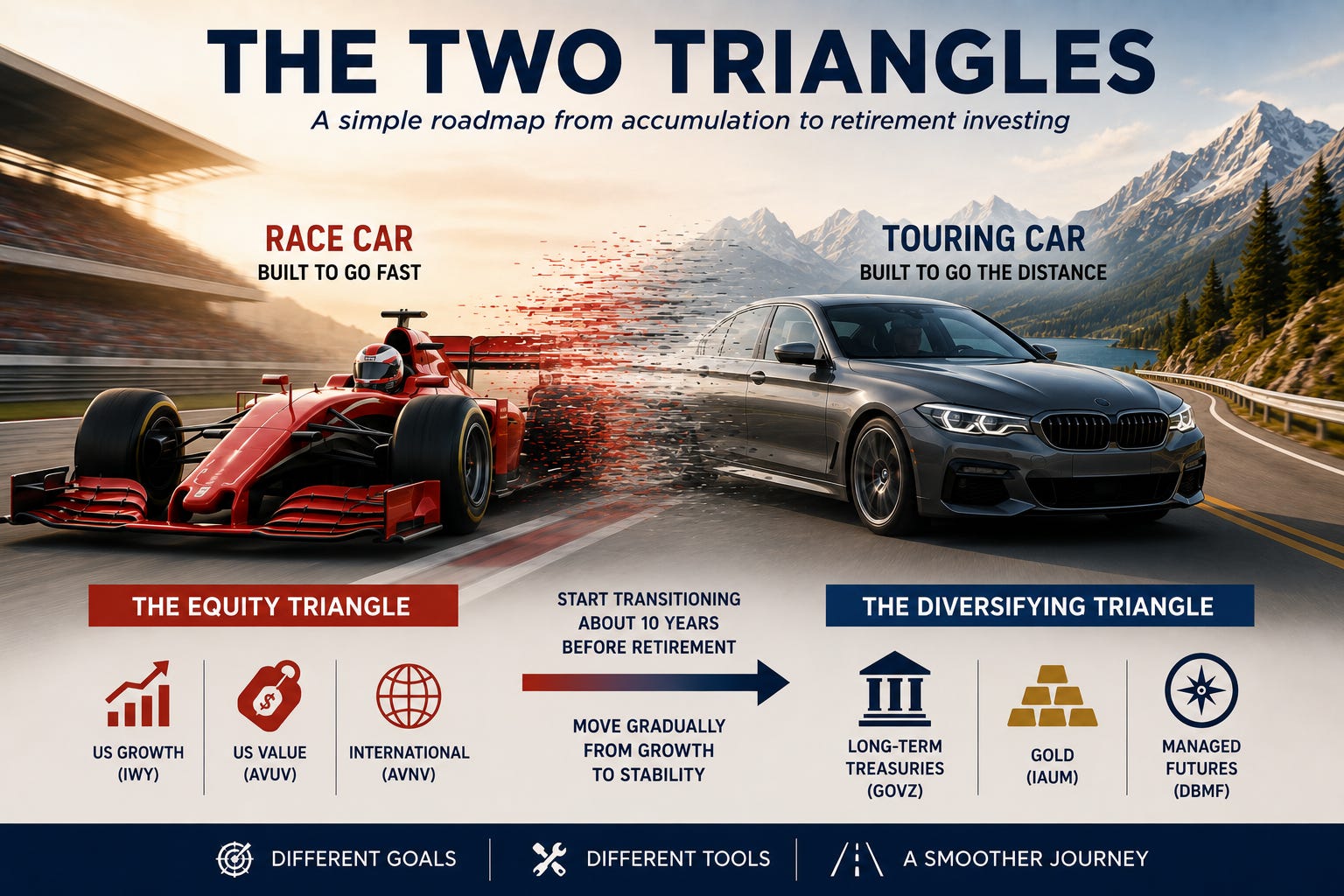
Back after a short summer break! While I was away, I found myself thinking about one of my recent posts and realized I’d left an important question unanswered.
In my deep dive on the Equity Triangle, I argued that a simple three-fund 100% equity portfolio is all most investors need during the accumulation phase of life. It’s easy to understand, to implement, and to maintain, all the while pushing you toward long-term wealth.
The portfolio is simply one-third in each of three funds:
As I mentioned in that post, you can substitute similar funds depending on what’s available in your brokerage or retirement plan. The important part isn’t the specific ETFs—it’s the exposure.
The Equity Triangle has both US and international stocks, along with complementary tilts toward growth and value. Historically, a portfolio like this has produced excellent long-term returns (for example, 10% over the last 21 years) while providing more diversification than simply owning the S&P 500 or Total Stock Market.
At the end of that article, though, I casually wrote something like this:
Use the Equity Triangle until you’re about ten years from retirement.
Then, start buying diversifying asset classes not in the Equity Triangle such as long-term bonds, trend-following managed futures, and gold.
The problem is...I never explained exactly what portfolio to target from there, or how to transition from one to the other. Over my break, I started thinking about what that transition should actually look like. Ideally, it should be just as simple as the Equity Triangle itself, with some simple rules for getting from one to the other.
Enter the Diversifying Triangle
If the Equity Triangle is designed to maximize long-term growth, the Diversifying Triangle exists for one purpose:
Protecting your wealth once you begin living off it.
Like its equity counterpart, it consists of just three asset classes:

These three assets tend to behave very differently from stocks. They won’t outperform equities over long periods—and they aren’t supposed to. Their job is to be there when stocks aren’t.
Best-in-Class Funds
In previous articles, I covered each of these asset classes individually. My current recommendations are:
GOVZ for extended-duration Treasuries (ZROZ and EDV are also excellent)
DBMF for trend-following managed futures (KMLM and TFPN are also strong choices)
Finding these investments can be a little trickier than buying stock funds. Many 401(k) plans don’t offer managed futures, for example.
But don’t let perfect become the enemy of good. Hold what you can where you can. If your retirement plan only offers bonds, buy your bonds there and hold the other assets in a taxable account. The exact implementation matters much less than simply beginning to diversify.
Managing the Diversifying Triangle
Management of this diversifying triangle is identical to the Equity Triangle.
Keep the three assets roughly equally weighted, but don’t worry about small deviations. Close enough is good enough.
Direct new contributions toward whichever holding is furthest below target.
Rebalance about once a year if you can do so without triggering unnecessary taxes (like in a retirement account)
If rebalancing would generate a taxable event, simply use new contributions to gradually restore balance. Conforming to the exact mix of thirds isn’t worth paying unnecessary taxes on.
The Psychological Challenge
With the Equity Triangle, the hardest part is dealing with volatility. My advice there was simple: Don’t look!

With the Diversifying Triangle, the challenge is different. If you follow it closely, you’ll see that its returns will likely be way lower than your equity investments. Once again, I beseech you: just don’t look.
Keep in mind: these assets aren’t designed to maximize returns. They’re insurance policies. When stocks are roaring ahead, gold, Treasuries, and managed futures often look disappointing.
Ironically, that’s exactly what you want.
Life insurance is a terrible investment if you judge it only by annual returns. You’re actually thrilled when it doesn’t pay out.
The Diversifying Triangle works much the same way.
Mixing the Two Triangles
Usually, at this point in a post about a portfolio, I’d show a few backtests illustrating how this construction would have performed over the years.
That doesn’t quite work here, though. The Diversifying Triangle isn’t meant to replace the Equity Triangle. It’s meant to be layered on top of it as retirement approaches. Therefore, it doesn’t really matter what its performance is on its own; instead, we want to see what it does when added, in different proportions, to a portfolio like the Equity Triangle.
This mix is totally up to the investor and their timeframe. The exact mix isn’t prescribed, and there is no need ever to sell everything and switch portfolios overnight. You simply begin directing new money toward the diversifying assets.
The main requirement: within each triangle, keep the three holdings equally weighted.
Then simply dial down the Equity Triangle and dial up the Diversifying Triangle. Even modest allocations improve diversification. As you continue increasing the Diversifying Triangle, portfolio stability and sustainable withdrawal rates improve further.
One possible endpoint would be a 50/50 split between the two triangles—meaning each of the six assets represents roughly one-sixth of the portfolio. Personally, I’d probably stop around 60% equities and 40% diversifiers, but the exact destination depends on your goals, timeframe, and risk tolerance.
Let’s Test It
Here’s what happens as more of the Diversifying Triangle is added to the Equity Triangle. Note: I’ll use simulated versions of certain funds in the broad asset classes, not the actual funds I’d use if I were implementing this now. We can get longer backtests that way, back to 1988:
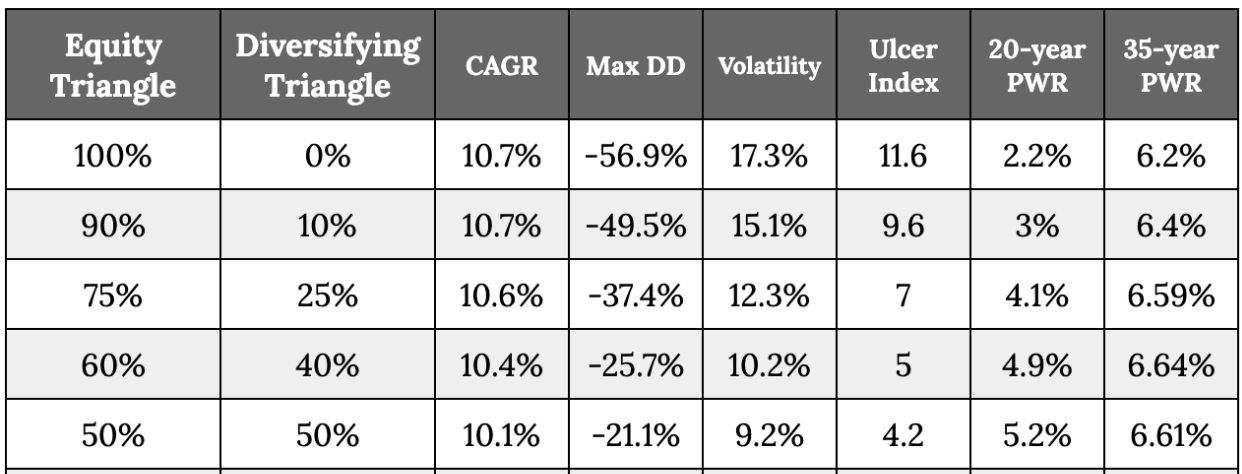
The trend is remarkably consistent, and a great illustration of the benefits of diversification. As you increase your allocation to diversifying assets…
Expected returns do decline, but only modestly.
Maximum drawdowns become dramatically smaller.
Volatility falls.
The Ulcer Index improves.
Most importantly, sustainable withdrawal rates rise substantially.
That’s exactly what we’d hope to see. During accumulation, maximizing growth is the priority. During retirement, maximizing spending becomes the priority.
The Big Picture
Despite my enthusiasm for Risk Parity, the Equity Triangle—with barely a whisper of Risk Parity influence—is still the portfolio I’d recommend to most investors during the accumulation years.
Then, about ten years before retirement, it’s time to begin building the Diversifying Triangle alongside it. Instead of making one dramatic change when retirement arrives, simply let the balance shift gradually over time. By the time you stop working, your portfolio will have naturally evolved into one designed not just to grow wealth, but to support spending it.
One Last Thought
Excuse the tortured metaphor, but the transition from the Equity Triangle to the Diversifying Triangle reminds me of building a car.
When you’re young and retirement is decades away, you’re building something like a race car. Its job is simple: go fast. The engine is everything. In a portfolio, those engines are your equities. They’re what drive long-term growth, and without them, you simply won’t get where you need to go.
But eventually, the goal changes. You’re no longer trying to build the fastest car—you’re trying to build one that can comfortably and reliably cross an entire continent.
A grand touring car still has a powerful engine, but it also has good brakes, responsive steering, a smooth suspension, traction control, and all the other features that make it stable when conditions become unpredictable.
That’s exactly what the Diversifying Triangle adds to a portfolio.
Treasuries help slow the damage during major market declines.
Gold can protect purchasing power during inflationary periods.
Managed futures can perform well in environments where traditional stock-and-bond portfolios struggle.
None of those things make the portfolio faster, but they’re not supposed to. Their job is to help you arrive safely.
For most of my working life, I’d happily drive the race car. But once the finish line starts coming into view, I’d much rather be behind the wheel of that grand touring car.
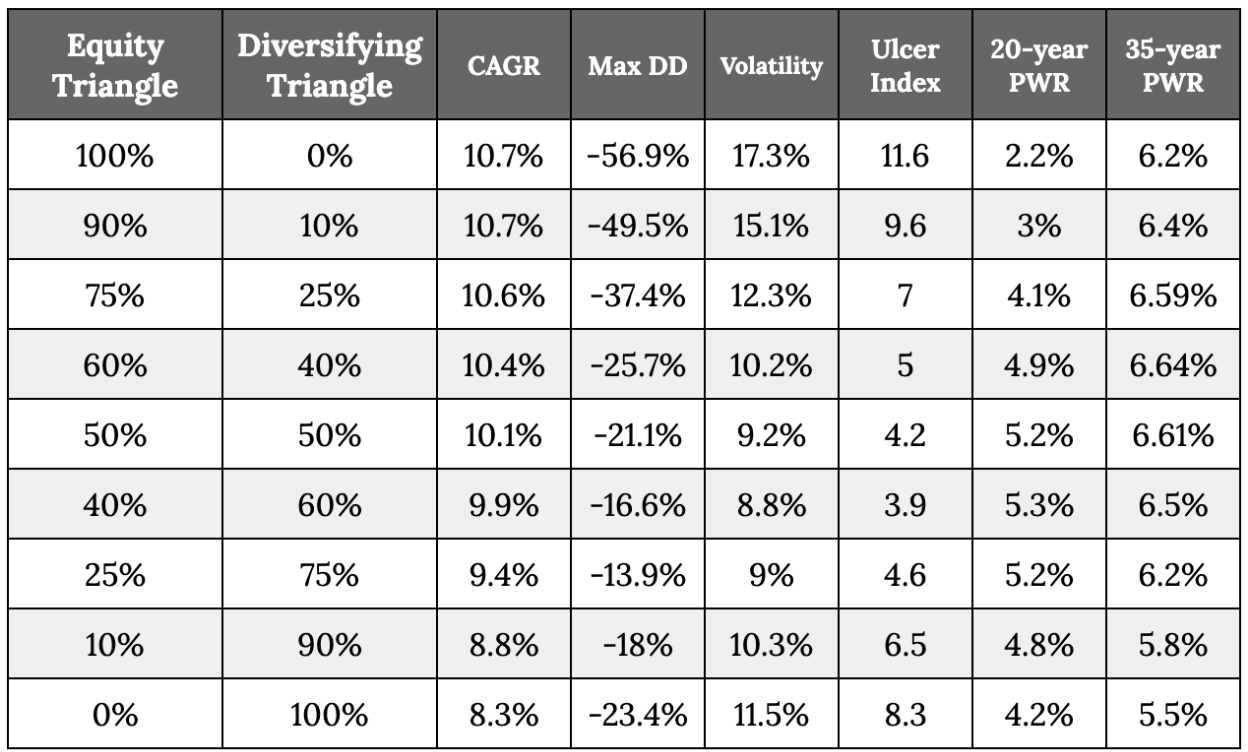
Postscript: Got a message a few hours after publishing (thanks, BP!) wondering what the table above would say for portfolios where the total portfolio was tilted towards the diversifiers. So, ran another backtest and made a new table below. Here is the link for both backtests (since you can only test five portfolios at a time), if anyone wants to play around with these themselves: Link for top half of backtest; Link for bottom half
I assume your diversifying triangle weights are based on dollars and not risk. if that's the case, then risk is skewed hard toward gold and bonds. it depends on the time period, but over the lifetime of DBMF, about 50% DBMF, plus 25% each bonds and gold, would realize rough risk parity. in tests, this increases Sharpe and Sortino along with return. granted, these tests necessarily cover a brief timespan, but it is intuitive that one would want to hold more DBMF than bonds or gold, based on their standard deviations.
Excellent post as usual. I am learning so much from your portfolio experiments, and the explanations behind them. It's a must-read for me each week.
Just one question: Substituting 50% IDMO and 50% AVDV for the AVNV portion? I realize you are trying to make a simple portfolio template, but that combo doesn't alter the simplicity much, duplicates the growth/value barbell approach used with the US stocks, and seems to produce higher yields. Thoughts?